


The Onryo
5-7 minute read
Hiroto packed up his fishing gear, gave a last nod to the old man, and started up the path
toward his grandfather’s kominka. Hiroto came up from Kyoto two or three times a year to help his grandfather keep up the old traditional Japanese home.
It was in a tiny village that always put Hiroto on edge. It was full of overgrown forests and
deserted houses. Most of the villagers had left long ago—or died. Only a handful of the old-timers lingered.
One of whom had invaded Hiroto’s quiet evening of fishing, appearing in the twilight and sitting beside him even though there was miles of empty river the old man could have chosen. Tomake it worse, he’d been chatty.
A foot scraped on the dirt path behind him. The old man must be heading home as well. He glanced behind, but there was nothing there.
It was that old man’s fault Hiroto was hearing things. He’d started off telling Hiroto all about the history of the village. Then he’d moved on to ghost stories. Well, story. It was just one. About an onryo. The angriest and most vengeful of all the yokai ghosts.
He heard footsteps again and spun around. Once more, the path was empty. “Haha, Ojisan,” he called out. “Nice try.” Now the old man was trying to scare him.
He had told Hiroto about a woman who’d lived in the village many years ago—during the
war. A group of soldiers came through, rounding up men for the military. Most of the men in the village had already been conscripted, but one family had a son who was just shy of age. The soldiers wanted him anyway. The boy’s mother objected, so they beat her, tied a rope around her neck, and hung her from a cedar. The last thing she saw was the soldiers dragging her son away.
According to the old man, it wasn’t long after that villagers started experiencing strange
things. Houses catching on fire. Mud slides. Freak accidents. All of them spaced years apart. But all of them causing death.
The woman had become an onryo—wandering the forest, searching for revenge.
“An onryo?” Hiroto had asked.
The old man nodded. “Born when a person dies with such rage, such hatred, they cannot find rest. They are entirely consumed with vengeance. They will not stop tormenting until they get retribution, however misguided that retribution may be. Even then, some cannot move on.
“When an onryo seeks vengeance,” the old man had said, “everyone must pay.”
Hiroto shuddered. He hitched his fishing bag over his shoulder and picked up his pace.
In the short time since he’d left the river, a low mist had settled in. The trees were now
ghostly figures with withered limbs reaching out of the fog. The haze swallowed all sound, and even his breath fell away as empty as the vacant houses. This village was far too creepy.
He caught sight of someone. A figure, a short ways up the path, wavering in the mist. The old man was taking it too far. Then the fog stirred, granting him a better view. It was a woman. Her shape shifted and drifted like a shadow on the waves.
“Sumimasen!” He shouted, asking who was there. He blinked and she was gone.
A loud crack splintered the night.
He screamed, leaping to the side as a huge tree teetered above him. He bolted forward, the branches raking down his back, nearly crushing him, as it slammed down.
The tree hit the path with a deafening crash, blasting twigs and needles. A woman’s laughter filled the air, coming from nowhere and everywhere at once, finally fading into mournful wail.
Hiroto took off sprinting. The wailing followed him up the path, growing louder and louder
until it thundered into his bones.
Then, the night fell silent.
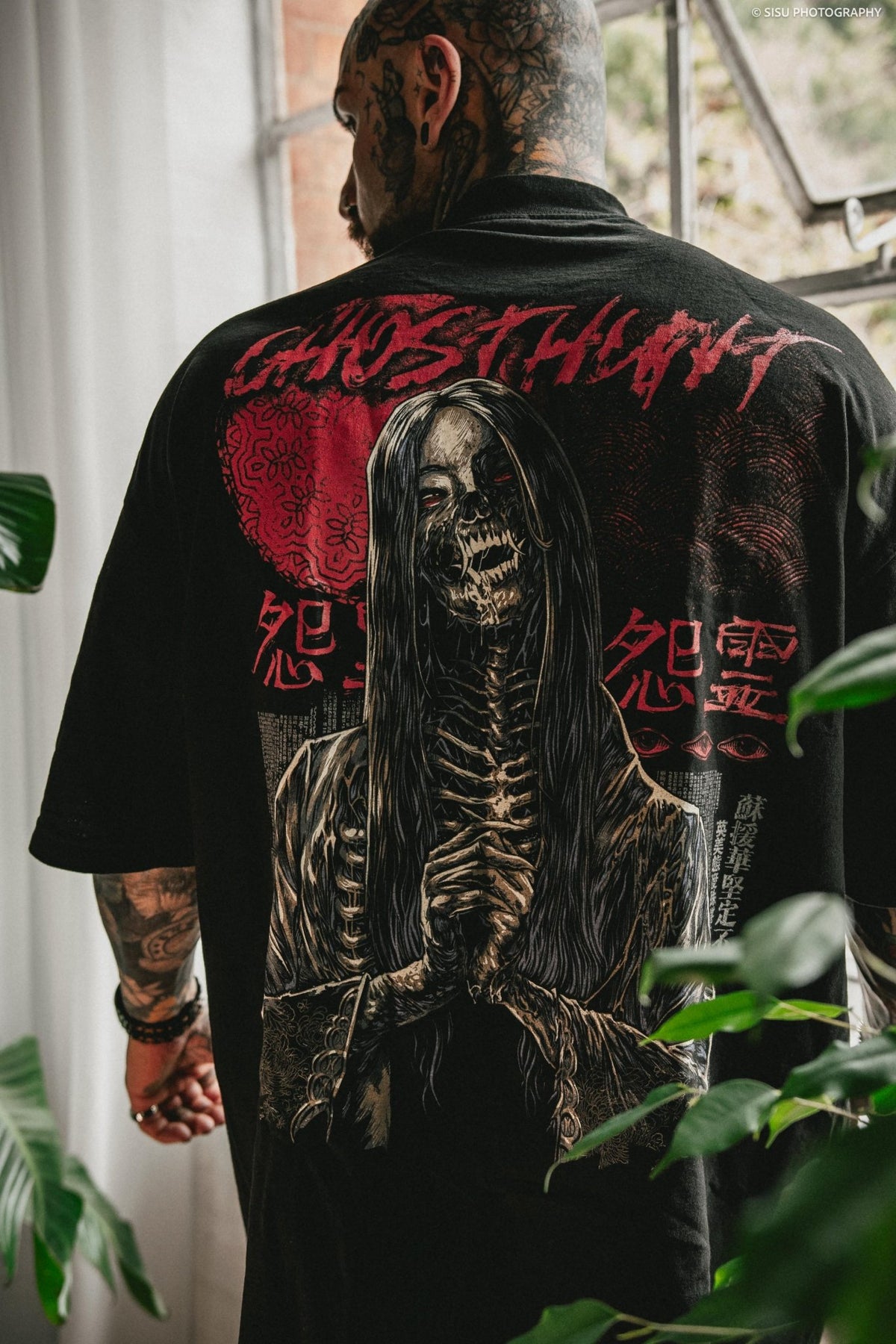
The woman materialized right in front of him. He skidded to a stop. She wore a white
kimono, her dark hair falling long and straggly over her skeletal face. Her pale bones stark
through her tissue paper skin.
He backed away.
The woman floated toward him. “Everyone must pay,” she said, with a slow and raspy voice.
He dropped his fishing gear and ran.
“Hiroto?” Takumi Ito greeted his grandson. “Did you catch any fish?”
“No,” Hiroto said. “A fog came in so I came home.”
“You look chilled. Come have some tea.” He led the way into the kitchen, sliding open a paper door and setting a pot of water over the large fire in the center of the room.
Takumi was grateful his grandson was willing to come help him, even though he knew
Hiroto mostly came for the fishing, and a chance to get out of the city. Hiroto had always been a quiet child. He was Takumi’s favorite grandchild, though he would never tell his daughter that.
Takumi poured the tea into a cup and handed it to Hiroto.
Hiroto took it, setting the cup to his lips. He tipped it, pouring the hot tea into his mouth. The liquid sloshed over his tongue, then leaked out through his throat and chest.
“Hiroto?”
His grandson looked up at him, the edges of his body wavering as if blowing in the wind. “It has been many years,” Hiroto said.
His voice was thin and raspy, but even so, Takumi recognized it. The voice of a woman
hanging on a tree.
“Everyone must pay.”
Got the chills? Capture that feeling with artwork from the original illustrator and others!
SHOP ONRYO

$3.00








$38.00